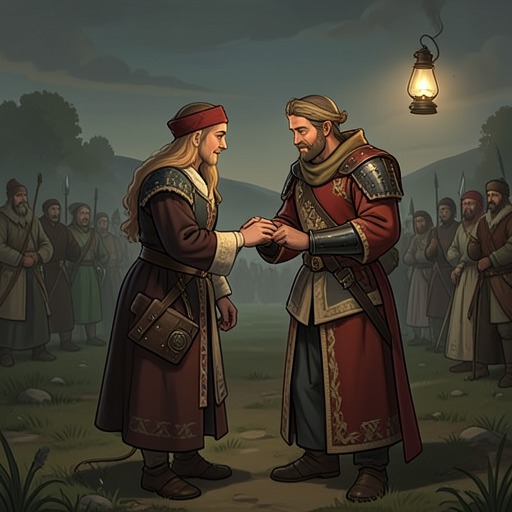
Revelation of Jaromir’s Engagement
The Ballad of the Last DragonThe Revelation of Jaromir’s Engagement is the decisive rupture between Sylvaine and Jaromir: a chance encounter with Thalon exposes that Jaromir is formally pledged to Rhosyn, who is later identified as the widow of his brother Damir. What had seemed to Sylvaine like a private, developing love is suddenly recast as a betrayal involving vows, family obligation, and a woman whose existence Jaromir had concealed.
The Accidental Disclosure
The revelation begins outside a tavern when Thalon, drunk but cheerful, recognizes Jaromir and embraces him with the easy familiarity of a childhood friend. Jaromir reacts with panic rather than pleasure, immediately asking why Thalon is there. Thalon explains that he has taken a carpentry job in town, building a new barn for his wife’s cousin after a fire destroyed most of the previous structure. His ordinary explanation contrasts sharply with Jaromir’s alarm, signaling that the danger lies not in Thalon’s arrival but in what Thalon knows.
Sylvaine is confused when Thalon speaks of Kalinia as a place Jaromir regularly visits, even though it is also the company’s next destination. Thalon then apologizes for failing to address her properly, bows, and kisses her hand so lingeringly that she has to pull free and discreetly wipe the wetness from her vest. Beneath the drunken manners, however, he supplies the crucial history: he has known Jaromir since childhood, grew up with Jaromir and Damir, and knew Jaromir’s betrothed. His casual reference to the betrothal makes private information public before Jaromir can control the conversation.
The Secret Made Explicit
When Sylvaine asks whose betrothed Thalon means, Thalon laughs and answers that it is Jaromir’s, while Jaromir watches her with a haunted expression. The chapter then isolates the revelation in stark repetition: Jaromir’s betrothed. Sylvaine’s response is not immediate weeping but a cold, broken laugh, an outward sound that registers the collapse of her understanding before she can fully process it. Her knees weaken as the emotional shock becomes physical.
The discovery forces Sylvaine to reinterpret the intimacy she and Jaromir have shared. She remembers his smiles, intent looks, heated kisses, gentle touches, and the buttercups he tucked into her bag and lute. Gestures that had signified tenderness now carry the stain of concealment. She accuses him of betraying a woman he plans to marry, while Jaromir reaches toward her and insists that the situation is not what it appears to be. Sylvaine refuses his touch, making the breach of trust visible in her body as well as in her words.
Duty, Paperwork, and Damir’s Widow
Jaromir declares that he has no attachment to anyone but Sylvaine and describes his agreement with Rhosyn as nothing deeper than paperwork. That distinction does not persuade Sylvaine. For her, the legal or formal nature of the pledge is precisely what makes it binding: Jaromir is still pledged, regardless of whether the arrangement contains love. His defense therefore fails to answer the moral injury she has identified.
Jaromir explains that he never wanted the arrangement but had been prepared to live with it and do what he believed was right after failing Damir. He says that meeting Sylvaine changed the terms of his life, and that, had he known what he would find with her, he would never have sworn vows to Rhosyn. Sylvaine then understands the missing connection: Rhosyn is Damir’s widow. Jaromir’s engagement is not merely an inconvenient prior promise but part of the responsibility he carries toward his dead brother and the family structure surrounding Damir’s death.
This clarification deepens rather than resolves the conflict. Jaromir’s feelings for Sylvaine may be genuine, but his honesty remains compromised because he pursued pleasure while already bound to another person. Sylvaine recalls that he could have refused her advances in the forest or told her the truth, yet he met her desire with eager hunger. The revelation thus changes the value of their relationship from mutual discovery to contested betrayal: love has not necessarily disappeared, but trust has been stripped from it.
The Rupture
Thalon attempts to place himself between them, but Jaromir’s threatening glare sends him retreating. Jaromir’s anger is directed at the interruption, while Sylvaine’s attention remains fixed on the broader betrayal—against herself, against Rhosyn, and against every moment in which Jaromir allowed her to believe that a shared future might be possible. His assertion that their relationship should not be diminished only intensifies her disbelief.
The confrontation culminates when Sylvaine rejects the relationship altogether and identifies its most painful fact: Jaromir is marrying his brother’s widow. Speaking the words aloud makes the hidden arrangement undeniable, and tears rise as she struggles to breathe. Fearing the onset of another panic attack, she pushes past Jaromir and leaves rather than remain within reach of his touch. The event therefore ends not with reconciliation but with separation, establishing the engagement as the central obstacle that must be confronted before their attachment can be understood or restored.
Narrative Function and Emotional Stakes
The disclosure operates as a romance midpoint reversal and a dark rupture rather than as a simple piece of background information. Before Thalon speaks, Sylvaine interprets Jaromir’s tenderness as evidence that their bond is becoming possible: his kisses, soft touches, and small gifts have made intimacy feel like a promise. Thalon’s careless announcement converts those same details into evidence of divided obligation. The scene’s force comes from that retrospective transformation; nothing about the earlier gestures changes, yet their meaning changes completely once the concealed pledge becomes visible.
The event also binds private desire to public and familial structures. Thalon’s familiarity with Jaromir reaches back to childhood and includes Damir, while his knowledge of Rhosyn places the engagement within a social network Jaromir cannot dismiss as an abstract contract. Jaromir’s explanation that the arrangement is only paperwork separates emotional attachment from formal duty, but Sylvaine refuses that separation. A pledge remains a pledge even without affection, and the existence of vows gives his secret encounters with her an ethical weight that his declaration of love cannot erase.
The revelation’s immediate consequence is a collapse of safety. Sylvaine cannot bear Jaromir’s touch, and her memories of physical closeness become inseparable from the feeling that she was denied the information necessary to choose freely. Jaromir acknowledges that he has made a mess of everything and admits he was prepared to fulfill the arrangement out of duty, yet his remorse arrives only after exposure. The scene therefore leaves the central relationship suspended between genuine attachment and irreparable deception: Jaromir claims that what he shares with Sylvaine is real, while Sylvaine can see only the vows he made elsewhere and the truth he withheld from her.
Narrative Function and Emotional Stakes
The disclosure functions as a romance midpoint reversal and a dark rupture rather than as mere background information. Before Thalon speaks, Sylvaine reads Jaromir’s tenderness as evidence that their bond is becoming possible: his kisses, gentle touches, and buttercups placed in her bag and lute have made intimacy feel like a promise. Thalon’s careless announcement converts those same details into signs of divided obligation. The earlier gestures remain unchanged, but their meaning changes once the concealed pledge becomes visible, forcing Sylvaine to reassess not only Jaromir’s conduct but also her own judgment of him.
The event binds private desire to public and familial structures. Thalon’s childhood familiarity with Jaromir and Damir, together with his knowledge of Rhosyn, places the engagement within a social network that Jaromir cannot reduce to an abstract contract. Jaromir separates emotional attachment from formal duty by describing his agreement with Rhosyn as paperwork, but Sylvaine rejects that distinction. A pledge remains a pledge without love, and the existence of vows gives Jaromir’s encounters with her an ethical weight that his declaration of exclusive feeling cannot erase.
The immediate consequence is a collapse of emotional and physical safety. Sylvaine cannot bear Jaromir’s touch, and memories of their closeness become inseparable from the sense that he denied her information necessary for an informed choice. Jaromir admits that he has made a mess of everything and says he had been prepared to fulfill the arrangement out of duty, but his remorse arrives only after the secret is exposed. The scene therefore leaves the relationship suspended between genuine attachment and compromised trust: Jaromir insists that what he shares with Sylvaine is real, while Sylvaine can see the vows he made elsewhere and the truth he withheld from her.
Narrative Function and Emotional Stakes
The disclosure functions as a romance midpoint reversal and a dark rupture rather than as mere background information. Before Thalon speaks, Sylvaine reads Jaromir’s tenderness as evidence that their bond is becoming possible: his kisses, gentle touches, and buttercups placed in her bag and lute have made intimacy feel like a promise. Thalon’s careless announcement converts those same gestures into signs of divided obligation. The earlier gestures remain unchanged, but their meaning changes once the concealed pledge becomes visible, forcing Sylvaine to reassess not only Jaromir’s conduct but also her own judgment of him.
The event binds private desire to public and familial structures. Thalon’s childhood familiarity with Jaromir and Damir, together with his knowledge of Rhosyn, places the engagement within a social network that Jaromir cannot reduce to an abstract contract. Jaromir separates emotional attachment from formal duty by describing his agreement with Rhosyn as paperwork, but Sylvaine rejects that distinction. A pledge remains a pledge without love, and the existence of vows gives Jaromir’s encounters with her an ethical weight that his declaration of exclusive feeling cannot erase.
The immediate consequence is a collapse of emotional and physical safety. Sylvaine cannot bear Jaromir’s touch, and memories of their closeness become inseparable from the sense that he denied her information necessary for an informed choice. Jaromir admits that he has made a mess of everything and says he had been prepared to fulfill the arrangement out of duty, but his remorse arrives only after the secret is exposed. The scene therefore leaves the relationship suspended between genuine attachment and compromised trust: Jaromir insists that what he shares with Sylvaine is real, while Sylvaine can see the vows he made elsewhere and the truth he withheld from her.